Bangkok · History
A 17-child kindergarten on Petchkasem Road led, four decades on, to Denla British School
Denla British School opened in 2017 on a 60-rai site in Nonthaburi, the international arm of a Thai family group that began in 1979 with a free home school for relatives and neighbours.

The school that became Denla British School began as a workaround. In 1979, a couple on Petchkasem Road in Bangkok found that sending their three-year-old daughter to the nearest school would mean her leaving home at five in the morning. They built their own instead. As the Bangkok Post has reported, that first intake was 17 children, all relatives and neighbours, taught for free by three teachers. The plan was to close when the cohort graduated. Demand made that impossible.
Origins of the Denla Group
The founder was Arn Pandejpong. Denla Kindergarten grew by reputation, added a second campus on Rama V Road in 2006, and eventually served around 3,000 children aged two to six across its two sites. The group was family-run from the start; Arn's sons, Dr Toryos and Dr Temyos Pandejpong, joined the business and introduced Total Quality Management to what had begun as a neighbourhood home school.
By the 2010s, the Pandejpong family was thinking beyond kindergarten. Thailand's appetite for English-language secondary education was rising, and the family saw a gap for a school modelled explicitly on the British independent sector rather than on a generic international curriculum. The result was Denla British School, incorporated under the Denla Group and opened for its first full academic year in August 2017.
The 2017 opening and phased growth
DBS opened with students aged three to ten and added a year group each year after that, reaching ages three to twelve by 2018 and building toward a complete through-school. Growing in phases, as many new British-curriculum schools in Asia do, let the leadership build culture and staffing before the senior years arrived.
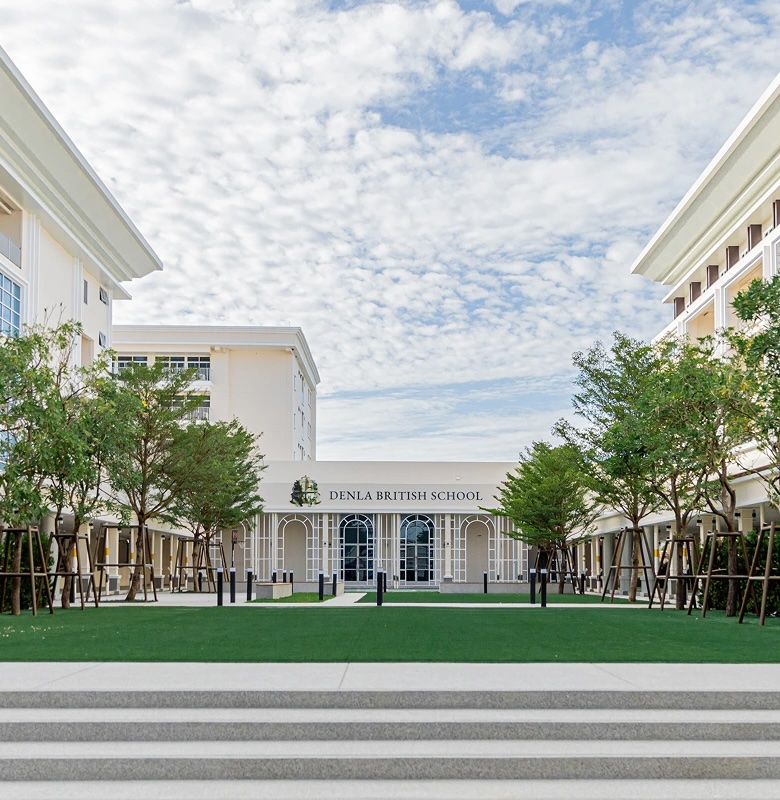
The campus chosen for the project was large by any standard. The school sits at 58 Moo 2 Ratchaphruek Road in Om Kret, Pak Kret, Nonthaburi, roughly thirty minutes northwest of central Bangkok by expressway. The site covers 60 rai, making it one of the largest international school campuses in Thailand by land area. The buildings were purpose-built to a British independent school brief: specialist science and technology laboratories, a makerspace, music and drama studios, an indoor pool, a 400-metre athletics track, a golf simulator, an indoor climbing wall, and three sports halls.
A significant expansion of the senior school came with two new upper-school buildings and Araya Hall, a 665-seat auditorium that also serves as a concert and performance venue. The expansion followed the school's growth into Years 11 through 13 and its aim to compete for post-16 students across the greater Bangkok region.
Curriculum and identity
DBS follows the English National Curriculum from Early Years through primary, with specialist subject teaching introduced from primary onwards. Students sit Cambridge IGCSE in Years 10 and 11, then A Levels in the Sixth Form. The school also runs Thai curriculum components alongside the British programme, a requirement for Thai national students and part of what the school calls preserving Thainess: Thai language, culture, and arts built into the timetable rather than treated as an add-on.
A structural feature that distinguishes DBS from most Bangkok rivals is the Extended Day, an additional 1.5 hours added to the standard school day. The school uses the time for academic work and co-curricular activities within the timetable, rather than leaving enrichment to optional after-school sign-ups.
The house system, modelled on British independent school practice, divides students into Windsor, Balmoral, Buckingham, and Sandringham, competing across academic, sporting, STEM, and charity events. Languages taught alongside English include Thai, Mandarin, and Japanese. The school is co-educational and day-only, with a shuttle bus service across the Nonthaburi corridor.
Accreditation
DBS joined FOBISIA, the Federation of British International Schools in Asia, in 2021. It later secured accreditation from the Council of International Schools (CIS) and became a COBIS accredited member, one of only four schools in Thailand to hold that status at the time of the announcement. Cambridge International authorises the school to offer IGCSE and A Level examinations; Pearson Edexcel and Oxford AQA approvals run alongside. Locally, ONESQA, Thailand's Office for National Education Standards and Quality Assessment, has accredited the school, as has ISAT, the International Schools Association of Thailand.
Present day
The school now enrols more than 900 students from around twenty nationalities, with Thai and regional Asian families making up most of the roll alongside a smaller expatriate group. Over 100 British teachers are on staff. Headmaster Jonny Liddell, who took the role in 2021, read Natural Sciences at Cambridge, holds a PGCE from King's College London, and completed the National Professional Qualification for Headship at the UCL Institute of Education. He is a Fellow of the Chartered College of Teaching and a trained inspector with the Independent Schools Inspectorate. Deputy Head is Richard Downs MBE.
The school reports a 100 per cent university admissions rate for its Sixth Form leavers. The Pandejpong Awards, a Sixth Form scholarship fund endowed by the founding family, support high-achieving students entering Years 12 and 13. The Denla Group now comprises three schools: Denla Kindergarten on Petchkasem and Rama V roads, DBS, and DLTS International School, which offers an American curriculum within an IB framework. What started with 17 children in a family home on Petchkasem Road now educates thousands of students across four campuses.